Like the ancient Egyptian pharaohs who placed belongings, furniture, mummified animals, food, etc… in their pyramids for the afterlife, the terracotta army of the first Qin emperor, Shi huangdi, was to help him rule some ‘afterlife’ empire. Even in the United States, this notion of the protective nature of the terracotta army has been captured on film. One of these movies that I can recall was a Disney movie “Wendy Wu Homecoming Warrior” in which the main character has to fight and destroy an evil being that keeps returning, who can summon up these terracotta warriors.
This is a 10 minute clip from "Wendy Wu, Homecoming Warrior", but you only need to look at the first minute to see some of the heroes fighting representations of the terracotta warrior.
Discovery and Description
In 1974, a group of peasants, while attempting to dig a well in the Shaanxi province, founded this army. While for centuries, pieces of the terracotta fragments and figures had been dug up in the area, this new discovery had prompted archaeologists to explore further. While these archaeologists were investigating, they noted some 18th – 19th century graves, in which the diggers had come across some terracotta fragments but discarded them as worthless. There are four pits:
 |
| Terra Cotta Pit 1 |
Terra Cotta Pit 1 à contains 6,000 warriors and horses (only 1,000 have been unearthed), and covers an area of ~19,000 square feet. They are placed in well-organized battle array. Pit 1, which is the largest pit, is set so that it seems like they are ready and prepared for battle at any point.
Terra Cotta Pit 2 à ~7,100 square feet, and is shaped in an L-Shape formation. This pit, while with only about 1,300 warriors, is more elaborate and complete than any of the other pits.
Terra Cotta Pit 3 à ~600 square feet, and has been deemed the command center. It contains 68 warriors, but no commander-in-chief…so it is often speculated that it is the Emperor Shi Huangdi, himself that is supposed to represent this commander-in-chief.
Terra Cotta Pit 4 à empty of warriors, and sometimes called the accessory pits, which includes builder’s graveyards, slaughter pits, animals pits, etc…
Construction and About Emperor Shi Huangdi
Shi Huangdi was emperor of the State of Qin from 246 BC to 221 BC, and then Emperor of China from 221 BC to 210 BC. He began ruling at 13 and was able to unify China by 221 BC. The very fact that he was able to unify China and then ushering in almost 2,000 years of imperial rule makes him a very significant figure. According to historian Sima Qian, the construction of this necropolis would begin in 246 BC and involve around 700,000 workers (A LOT!) so basically he started this necropolis right when he became emperor of the State of Qin—almost seems like a testament to his confidence and thoughts about his abilities as a ruler. The terracotta warriors were manufactured in workshops by laborers and craftsmen and each were given different features and facial expression. The warriors are also life-size and vary in height, uniform, hairstyle in accordance to their rank.
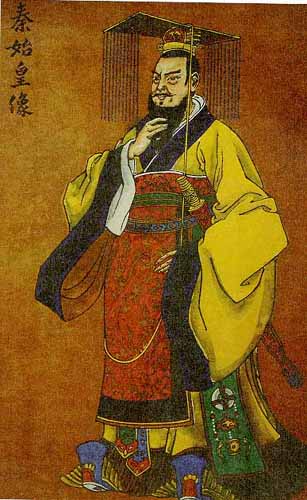 |
| Shi Huangdi |
I think it is pretty cool that there is such a large monument devoted to one man – I wouldn’t mind a necropolis for myself :D


